Climate Killer Charcoal

Climate Killer Charcoal

Nice and warm summer evenings, cold beer and a spicy steak on the hot embers – isn’t that most beautiful? This film is not about the grilled food on the grill, but about the coal that makes it glow: 243,000 tons of charcoal is imported annually by Germany; The trend is ascending, because barbecue is hip in Germany. With 59,000 tons Poland is the main supplier for Germany, followed by Nigeria with 31,816 tons. In total, 40 percent of Europe’s total consumption of charcoal comes from African countries. Much of it from dubious, often illegal structures that earn a lot of money with it. The revenue from illegal charcoal exports in East, – West, and Central Africa exceed with over US $ 7.4 trillion almost the triple the value of illegal drug trafficking.

Moreover, 2.7 billion people around the world cook and heat with wood or charcoal. The related emission of climate gases is enormous. 55 percent of global wood is used as fuel per year. Especially during dry periods, local Nigerian farmers use coal production as a lifeline to feed their families. Charcoal mills roam the countryside in family groups, charring all the trees they can cut down. To produce one ton of charcoal, three gallons of wood are needed in efficient oilers. In contrast, the self-built charcoal kilns of informal Nigerian charcoal makers use up to twelve tons. The effects are enormous.

In Nigeria alone, where most of the charcoal produced is destined for exports, since the country itself mainly relies on kerosene, 36 percent of its forests were lost between 1990 and 2005. At present, twelve percent of the country is covered with forest – but coal production continues to increase. 350,000 hectares of fertile land are lost here every year. According to the UN, coal production is one of the main causes of Africa’s deforestation and, closely linked to this, the massive deterioration in soil quality and the growing risk of crop failure. Trees provide a moister microclimate, consequentially they hold water. Due to the loss of trees, the soil lacks support, and the fertile humus layer is simply washed away during heavy rainfall.

The research for this project was supported by a scholarship from the non-profit Olin gGmbH and supervised by the journalist’s association netzwerk recherche.

Searching for sustainable gold

Searching for sustainable gold

With mere hammers they knock chunks out of the rock. Every year, 727t of mercury is released worldwide through gold mining in informal mines, which makes gold production the greatest mercury polluter. And everything for the dazzling symbol of wealth: gold. The documentary accompanies the renowned Hamburg goldsmith Jan Spille, who has been campaigning for fair and ecological gold mining for many years, as he visits the first Fairtrade certified mines in Kenya and Uganda.

Jonathan Happ

Jonathan Happ

Jonathan specialised himself as a researcher and journalist on the development of East Africa and travelled that region uncounted times. “Curiosity keeps me busy in many ways. Climbing down a pit or driving through the desert, always accompanied by my camera.  It never bothered me, having spent hours needed in the depth of the world wide web or in the heat of Africa…”

Until the Last Drop – Makwekwe’s journey into the Future of Lake Turkana

Until the Last Drop – Makwekwe’s journey into the Future of Lake Turkana

A short documentary about the importance of Lake Turkana for the indigenous people in northern Kenya. Seen from their own perspective and expressed in a modern artistic way, which delivers the alarming message packed in a positive tune. ‘Until the Last Drop’ was produced in 2016 and is running in 2017 on various international film festivals. Among others in Los Angeles, Toronto und Budapest. In Germany, the film premiered at Germanys oldest festival in Oberhausen and is nominated at the GREEN SCREEN, Europe’s largest annual wildlife film festival, as best short.

Makwekwe is an up-and-coming Kenyan Hiphop artist and son of the peaceful El Molo tribe- the smallest ethnic group in Kenya. Today, the El Molo people number roughly 500 people, who stick to their traditional way of life and speak their own language. They live on the shores of Lake Turkana in northern Kenya- the world’s biggest desert lake and home to ~300,000 people, mostly from the pastoralist Turkana tribe.

The film follows Makwekwe on his impressive journey through the dramatic landscape of the region to learn more about the importance of the lake for his community and their neighbors, because in 2017, their lake is rapidly disappearing. The recently finished Gibe 3 hydroelectric dam in Ethiopia pulls water from the Omo River, upon which Lake Turkana depends for 85% of its inflow. Lakeside communities are watching the waterline retreat, which puts their life in danger. More alarmingly, he learns that there are 2 more dams scheduled to pull water from the same river to cultivate export sugar and cotton.

How will the future of the Omo River and Lake Turkana communities look when their lifeline has vanished? Makwekwe believes he has found the answer when he visits Kenya’s Kakuma refugee camp. Upon seeing the communities permanently living there as regional war refugees, he knows that a camp like this would mean the end of his people’s way of life. As an artist, his response is his music. As an El Molo, his hope is that his songs will carry a message of salvation.

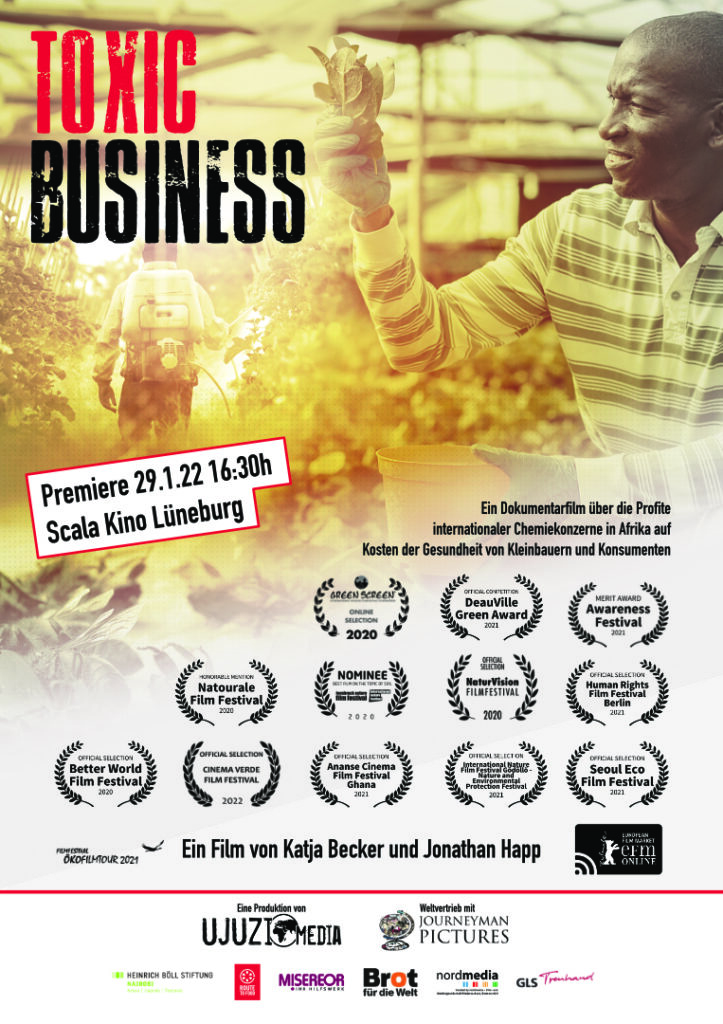
Toxic Business

Toxic Business

Übersicht kommende Filmvorführungen von Toxic Business

A documentary on the profits international chemical companies are gaining in Africa at cost of the environment, health of small-scaled-farmers and consumers. The film inspired a movement on the African continent.

International chemical companies sell high toxic agro-chemicals in Kenya, which are banned since long in Europe. They are banned because their ingredients cause cancer and have a major negative impact on the nature and environment. Anyhow – in developing countries like Kenya those toxic chemicals are sold without any regulations through small agro-shops all over the country. The small scaled farmers do believe in the promises of better and safer harvest those companies give. Today, the use of pesticides even inside the villages is already a daily business. Furthermore many of them already depend on hybrid seeds, old and resistant seeds supplants. Most of the consumers do not have the knowledge, how dangerous those agro-chemicals are: the WHO announced that annually 346.000 people die, caused by accidentally poisoning with those chemicals, 2/3 of them within developing countries.

In the face of world food, industry is trying to push its way into the markets. On the contrary, statistics and alternative farming methods in East Africa show that it no longer needs chemicals and hybrid seeds to feed the world, but a general rethinking.

This film inspired a Kenyan politician Gladys Shollei supported by local NGOs to hand in a petition to withdraw a range of highly hazardous pesticides from the Kenyan market. In 2021 the CEO of the Kenyan registration body was replaced and more than 20 active ingredients are reassessed for approval based on their environmental and human health hazard. 

Jean-Jacques Schwenzfeier

Jean-Jacques Schwenzfeier

Jean-Jacques mainly workes behind the scenes and keeps himself busy with citizen journalist concepts and the ethics of reporting for a sustainable work with media. “Too much time at home makes me nervous.”

Legacy Warnings!

Legacy Warnings!

The Threat

Around Johannesburg the impact of uranium mining is widely detectable. Huge parts of its population struggling with its Legacy. South Africa is the only African country running two nuclear power stations. One as a source of energy, the second infamous for its accidents. The president Jacob Zuma pushes a program to extend its nuclear capacities by 9600MW in what would be the biggest infrastructural project for the country ever. Other African countries showing interest in nuclear as well. The Legacy and tradition of grassroots protest makes the opposing population a player to count with.

The legacy

About 2,5 million people are living close to South Africa’s radioactive and toxic mine dump sites, containing high levels of uranium, sulphates, cyanides. The toxic dust finds its way into the food chain by acid mine drainage, leakages and radioactive dust. The sludge is being used for cosmetics, Kids play soccer on radioactive dust, people use polluted water for irrigation. The number of disabled kids is alarmingly high. The industry behind is escaping its responsibilities.

The issue

We went to see the begin of nuclear energy, such as it presents itself in South Africa, the mining of uranium and the associated status and expansion plans in the Country and how it effects the so-called African Nuclear Renaissance. Does nuclear energy have a chance for being the solution to climate change? Is it a clean energy, such as the industry promotes it?

The people

Many people live on or near toxic mine dump sites with many knowing about the hazards, but having nowhere to go or nobody to complain to. The mining industry ever increasing its territory and devastating whole landscapes. Resistance on the ground is loosely connected, but growing.

The hope

Activists say there is a historical momentum found in Africa now, as energy is a key issue and infrastructural changes will need to happen and will happen. The market is ever developing. Africa could become a renewable continent. ‘Prevent a whole continent from becoming nuclear – Provide tools and help for renewables instead’ and ‘It can still be stopped!’ What positive example of developing renewables do countries like Germany give and how could that relate to South Africa?

Röszke // Borders Kill

Röszke // Borders Kill

In the end of 2015 an enormous influx of refugees developed at the European frontier between Hungary and Serbia. A majority of those fled bombs and war crimes in Syria, but within the EU, the readiness for admission tipped. Right-wing conservative politicians, in particular the Hungarian Prime Minister Viktor Orbán, campaigned for a zero-tolerance policy towards those seeking help. Hungary quickly constructed a virtually insurmountable fence along its outer border and used all state resources to seal off the country. We were on site in the last days before the border closure and have witnessed on film the last hours of the Balkan route.

Refugeecamp Röszke

Röszke – a small town on the Hungarian border, the last open eye of the needle for refugees to Hungary, dramatic and frightening. Volunteers from all over the EU are there to help.

Borders Kill – Die letzten Tage der Ungarn-Route

Tens of thousands of refugees have entered Hungary over the Balkans route in recent days. Most of them only want to travel through the country to find a new home in Western Europe. The wars in their mother countries force them to flee. But Hungary’s government is closing and rejecting people.